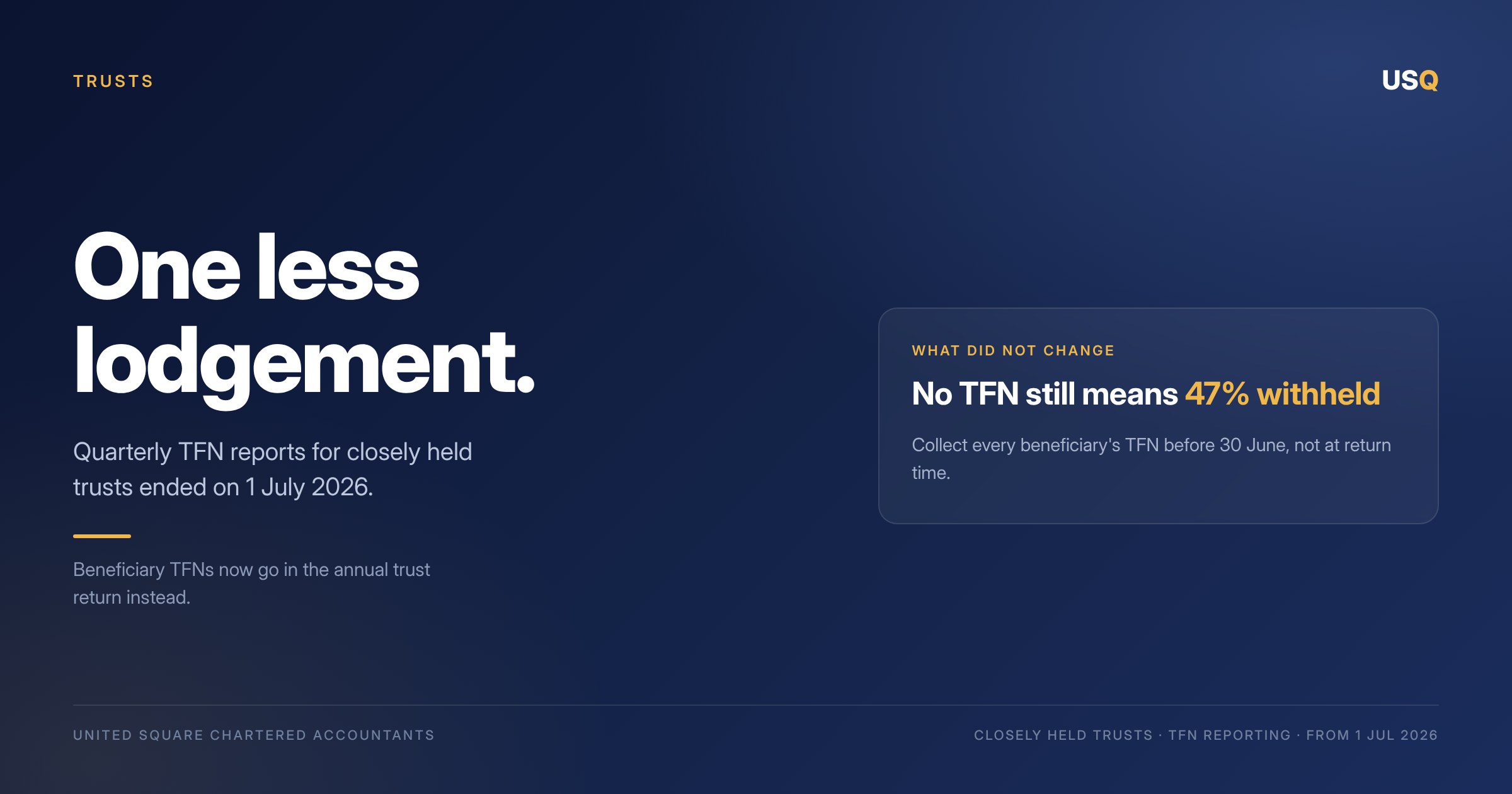
If you are the trustee of a family trust, you have one fewer lodgement to think about. From 1 July 2026, trustees of closely held trusts no longer lodge quarterly TFN reports for beneficiaries.
The final quarterly report — for April to June 2026 — was due 31 July 2026. After that, the obligation stops.
What replaces it
Beneficiary tax file numbers now go in the statement of distribution with the annual trust tax return. One annual disclosure instead of up to four quarterly reports.
From the 2027 trust return the ATO is adding extra labels for cases where a beneficiary has not provided a TFN, so the gap becomes visible on the return itself rather than in a separate report nobody outside the practice ever looked at.
What did not change — and this is the important part
The TFN withholding rules are untouched.
If a beneficiary becomes presently entitled to trust income and has not quoted their tax file number to you beforehand, the trustee must still withhold at the top marginal rate plus Medicare levy — currently 47% — and pay it to the ATO.
That has not been relaxed. It has not been deferred. All that changed is where you report it.
So the risk profile is the same, but the early-warning system is weaker. Under the old rules the quarterly report was a regular prompt to notice a missing TFN. Now the moment you discover it is when the return is being prepared — which is months after the distribution, and far too late to fix the withholding.
What a trustee should actually do
Collect every beneficiary's TFN before 30 June, not at return time. That is the whole of the practical advice.
For most family trusts this is a five-minute job that nobody does. The beneficiaries are a spouse, adult children, sometimes a related company. The TFNs exist. They are simply not written down anywhere the trustee can find them in July.
A few points worth checking while you are at it:
- A new adult beneficiary — a child who turned 18 and is now in the distribution for the first time — is the most common gap.
- A corporate beneficiary quotes its TFN too. Companies are not exempt from this.
- TFNs only need to be quoted once, not every year, so this is a one-off per beneficiary rather than an annual chore.
- A beneficiary cannot be compelled to quote a TFN. If they genuinely will not, the withholding applies and the trustee must account for it — which is a conversation to have in May, not after the distribution resolution is signed.
Does this apply to your trust?
Broadly, a closely held trust includes most family discretionary trusts, and fixed trusts where 20 or fewer individuals hold 75% or more of the income or capital. If you have a family trust, assume it applies and let us confirm.
If you are a USQ client with a trust, we will raise this with you before the June distribution resolutions rather than at return time. If a beneficiary has joined your trust recently, send us their TFN now and it is handled.
This is general information, not personal tax advice. Your circumstances change the answer — please talk to us before acting on it.