Calling someone a contractor doesn't make them one. Neither does giving them an ABN, or paying them on an invoice. Since two High Court decisions in 2022, the answer for tax and super comes from one place: the contract you have with the worker.
Getting it wrong is expensive. If a worker you treated as a contractor turns out to be an employee, the business can owe the super it should have paid, plus the super guarantee charge, plus penalties for not withholding tax. That is usually discovered years later, when it is hardest to fix.
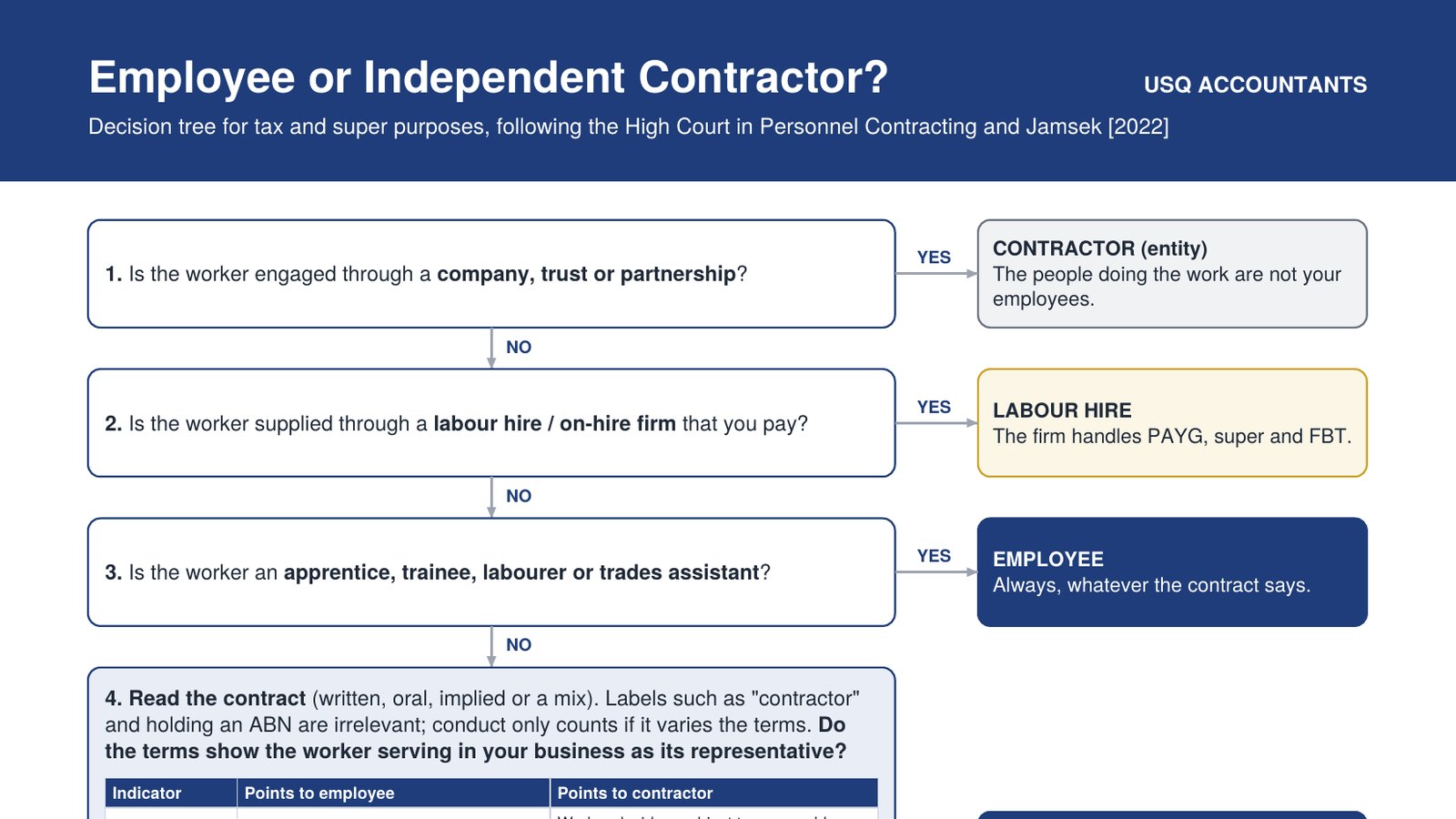
We've put the whole test on one page as a decision tree. Download it below, then read on for how it works.
Download the decision tree (PDF): English · 한국어
What changed in 2022
In CFMMEU v Personnel Contracting and ZG Operations v Jamsek, the High Court said the relationship is decided by the legal rights and obligations in the contract. The ATO follows this approach.
That means:
- The contract decides. It can be written, verbal, implied from how you deal with each other, or a mix of these.
- Labels don't count. Calling the arrangement "independent contractor" in the contract, or the worker holding an ABN, doesn't settle it.
- Day-to-day practice mostly doesn't count either. How the work actually happens only matters where it has changed the terms of the contract.
The question to ask is simple: under the contract, is the worker serving in your business, as its representative? Or are they running their own business and providing a service to yours?
Some workers have a fixed answer
Before looking at the contract, check these:
- Company, trust or partnership. If you engage an entity, it is a contractor. The people doing the work for it are not your employees.
- Labour hire. If the worker comes through a labour hire or on-hire firm that you pay, the firm handles PAYG withholding, super and fringe benefits tax.
- Apprentices, trainees, labourers and trades assistants are always employees, whatever the contract says.
The indicators
For everyone else, look at what the contract says about each of these. No single one decides it. Weigh them together, and don't treat them as a checklist.
| Indicator | Points to an employee | Points to a contractor |
|---|---|---|
| Control | You can direct how, where and when the work is done | The worker decides, subject to reasonable direction |
| Integration | Works as your business's representative | Works to build their own business |
| Pay | By the hour, per item or by commission | A fixed fee for a specified result |
| Delegation | Must do the work personally | A real right to subcontract (not a sham clause) |
| Tools | You supply them, or reimburse or pay an allowance | The worker supplies them at their own cost |
| Risk | You bear the cost of injury or defective work | The worker bears it |
| Goodwill | Goes to your business | Goes to the worker's business |
A contractor can still be owed super
This is the trap we see most often. A worker can be a genuine contractor for tax and still count as an employee for super. That happens when:
- the contract is wholly or principally for their labour, such as a contractor paid mainly for their own work and skill rather than to produce a result;
- they do domestic work for more than 30 hours a week;
- they are paid for sport, arts or entertainment, or for film and broadcast work.
In those cases you must pay super guarantee to their fund, even though you don't withhold tax from their pay.
If you're unsure, you can choose to pay super to a contractor anyway. That removes the super guarantee charge risk. If you do, put it in the contract.
If they are a contractor
- No ABN, no payment in full. If a contractor doesn't quote an ABN, you must withhold 47% from the payment (unless there is a voluntary withholding agreement).
- TPAR. Businesses in some industries, such as building and construction, cleaning and courier services, must report contractor payments to the ATO each year on the Taxable payments annual report.
Other tests can give a different answer
The decision tree is for tax and super. Other laws use their own tests:
- Fair Work Act. Since 26 August 2024, employment status under the Fair Work Act looks at the whole relationship, including how the work is actually done. A worker can be a contractor for tax and an employee for Fair Work purposes.
- Payroll tax. Victoria's relevant contract rules can bring payments to genuine contractors into your taxable wages.
- WorkCover. It has its own deeming rules.
What to do now
- List everyone you pay who isn't on payroll. Include family members, and regular "casuals" paid by invoice.
- Find the contract for each. If there's no written contract, write down what was agreed. That is still the contract.
- Run each one through the decision tree.
- Talk to us about anyone who lands on "employee" or "employee for super". It is much cheaper to fix early than after an ATO review.
If you'd like us to review your arrangements, contact USQ Accountants on 03 9070 4790.
Source: ATO, Difference between employees and independent contractors (updated 17 December 2024); TR 2023/4; SGR 2023/1. This article is general information, not advice for your particular arrangement.