New foreign resident capital gains tax rules started on 1 October 2026, and they have had a lot of coverage. For almost everyone reading this, they are irrelevant: they deal with disposals of membership interests worth $50 million or more, and they are aimed at large corporate groups.
The foreign resident rule that actually catches people selling a house or an investment property is older, and it is far less talked about. It applies to Australian residents as well, and it costs 15% of your sale price if you get it wrong.
The rule
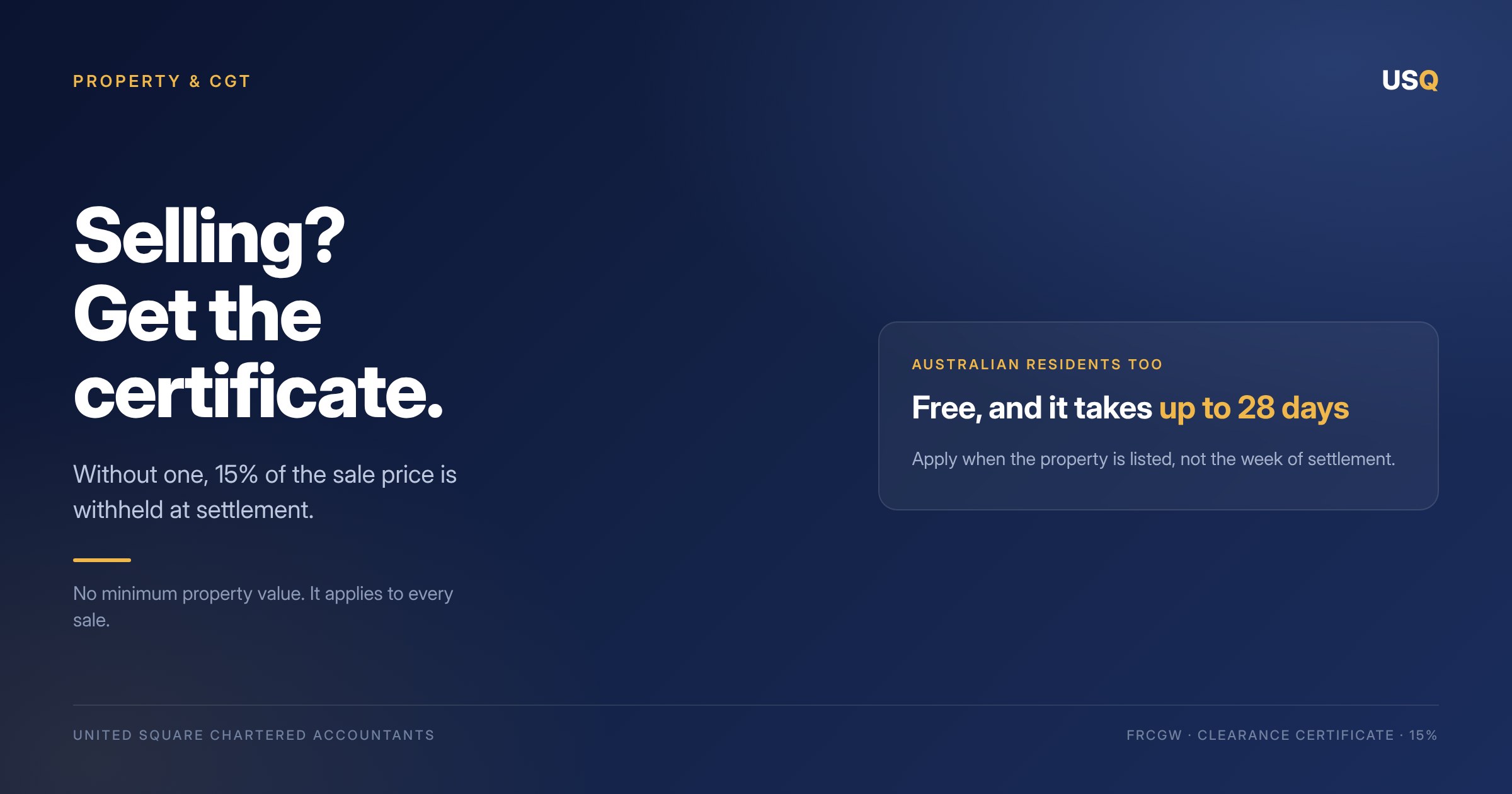
When you sell Australian property, the purchaser is legally required to withhold 15% of the sale price and pay it to the ATO — unless you hand them a valid clearance certificate at or before settlement.
Two details make this bite harder than people expect:
- There is no minimum property value. Until the end of 2024 the rule only applied to properties over $750,000, and the rate was 12.5%. Since 1 January 2025 the threshold is gone and the rate is 15%. Every sale is caught, including a modest unit.
- It is not only for foreign residents. The certificate is simply how you prove to the purchaser that you are not a foreign resident. No certificate, no proof — and the purchaser has to withhold regardless of where you actually live. They have no discretion in this; they are personally liable if they don't withhold.
What it costs to get this wrong
If 15% is withheld, you have not lost the money. You claim it back as a credit in your tax return.
But think about the timing. Settle in November, and you are claiming that credit in a return lodged the following July at the earliest — and the refund arrives after that. On an $800,000 sale, that is $120,000 sitting with the ATO for the better part of a year.
If you were relying on those proceeds to pay out a mortgage, settle on your next place, or put money into the business, that is not an inconvenience. That is a deal falling over.
What to do
The certificate is free, it is valid for 12 months, and the ATO says it can take up to 28 days to issue. Most come back quickly, but the ones that don't tend to be the complicated ones — trusts, deceased estates, recently changed names, or anyone whose ATO records are not perfectly current.
So the rule of thumb is simple: apply when the property goes on the market, not when settlement is booked. A certificate issued and unused costs you nothing. A certificate still processing on settlement day costs you 15%.
A few points that catch people out:
- If the property is in more than one name, each owner needs their own certificate. One certificate covering a couple is not a thing.
- Check the name matches the title exactly. A certificate in a married name against a title in a maiden name will be rejected by the purchaser's conveyancer.
- If the vendor is a trust or a company, the certificate is in the entity's name, not the director's or the trustee's personally.
- If you genuinely are a foreign resident, you cannot get a clearance certificate — but you can apply for a variation if 15% of the price is more than the tax you will actually owe. That also takes time.
If you are a USQ client and you are thinking about selling, tell us when you list rather than when you have a contract. Applying for the certificate takes us a few minutes and removes the single most avoidable problem in a property settlement.
This is general information, not personal tax advice. Your circumstances change the answer — please talk to us before acting on it.